

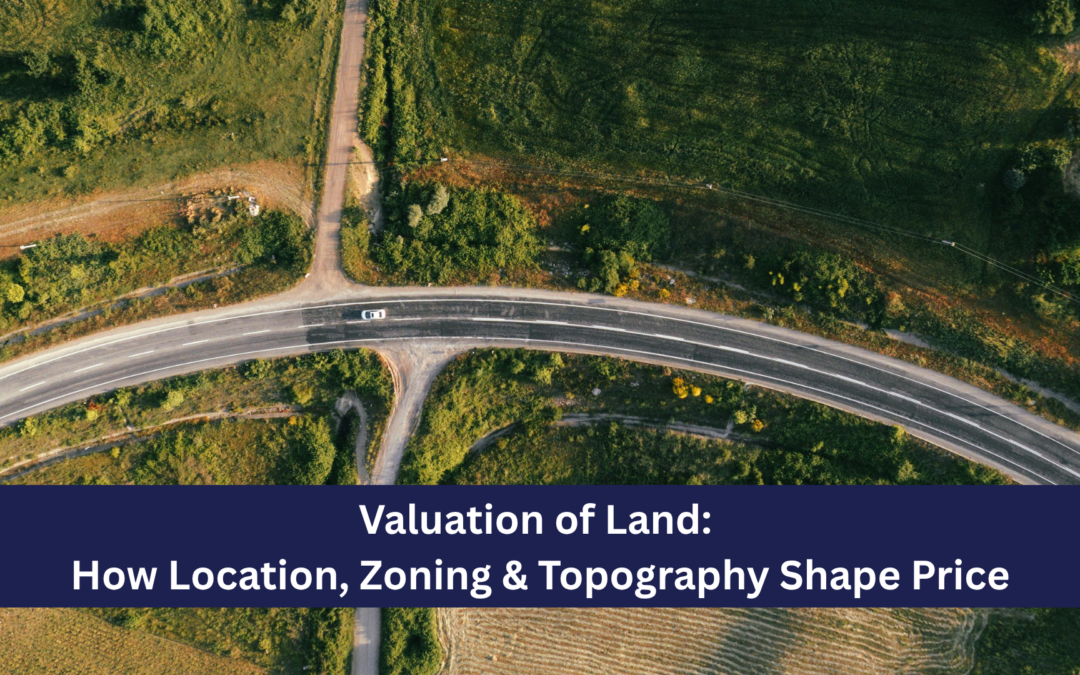
When it comes to real estate investment, land is often considered the purest form of asset. Unlike buildings, which depreciate over time, land generally appreciates. However, determining the “fair market value” of a piece of earth is far more complex than simply looking at its size. At www.Valuer.co.in, we understand that the valuation of land is a multidimensional process.
Whether you are a developer, an individual buyer, or an investor, understanding the core pillars of land pricing—Location, Zoning, and Topography—is essential for making informed decisions.
1. Location: The Undisputed King of Value
The long-standing real estate principle “location, location, location” carries unmatched significance in land valuation, as land is immovable and its value is fundamentally determined by its surroundings.
- Connectivity and Infrastructure: Land situated near major highways, airports, or upcoming metro stations commands a premium. Proximity to urban hubs reduces transit costs and increases the land’s utility for both commercial and residential purposes.
- Neighborhood Quality: For residential land, the presence of schools, hospitals, and shopping centers drives prices up. Conversely, land located near industrial dumping grounds or high-noise zones often sees a significant dip in value.
- Future Development: Valuation is not just about the present; it’s about anticipation. A barren plot today might be worth a fortune tomorrow if a government-sanctioned “Smart City” project or a new tech park is planned nearby.
2. Zoning and Land Use Regulations
You might find two identical plots of land side-by-side with vastly different price tags. The reason often lies in “Zoning.” Zoning laws are regulations set by local municipal authorities that dictate how a piece of land can be used.
- Residential vs. Commercial vs. Industrial: Commercial land is typically more expensive than residential land because it has a higher income-generating potential. If a plot is zoned for high-density residential use (allowing for high-rise apartments), its value will be significantly higher than a plot zoned for single-family homes.
- Floor Space Index (FSI) or Plot Ratio: This is a critical factor in the valuation of land. FSI determines how much construction can be done on a specific plot. A higher FSI allows for more floor area, which directly translates to higher profitability for developers and, consequently, a higher land price.
- Legal Encumbrances: Land value is also shaped by legal clarity. Plots with clear titles, no litigation, and adherence to “Change of Land Use” (CLU) norms are valued much higher than “disputed” or agricultural land that hasn’t been converted for non-agricultural use.
3. Topography and Physical Characteristics
While location and zoning deal with the “where” and “what,” topography deals with the “how.” The physical attributes of the land can either facilitate or hinder development.
- Terrain and Elevation: Perfectly level land is the gold standard. If a plot is hilly or has a steep slope, the cost of “cutting and filling” to make it buildable adds to the development budget, which lowers the initial land value. However, in luxury segments, a sloped terrain might be valued higher if it offers panoramic views.
- Soil Quality: For agricultural land, soil fertility is the primary value driver. For construction, the load-bearing capacity of the soil is vital. Land with rocky foundations is easier to build on than marshy or sandy soil, which requires expensive piling work.
- Shape and Frontage: A square or rectangular plot is easier to plan than an irregularly shaped one. Furthermore, “frontage”—the width of the land facing the main road—is a major price determinant. More frontage usually means better visibility and access.
Why Professional Valuation Matters
The valuation of land is not a DIY task. It requires a deep dive into local market trends, a thorough check of municipal records, and a technical assessment of the physical site. At www.Valuer.co.in, we combine data-driven insights with years of on-ground expertise to provide accurate land appraisal services.
Understanding these three pillars—Location, Zoning, and Topography—allows you to see beyond the dirt and grass. It helps you identify whether a piece of land is a hidden gem or a financial pitfall. When you invest in land, you aren’t just buying space; you are buying the potential of what that space can become.