

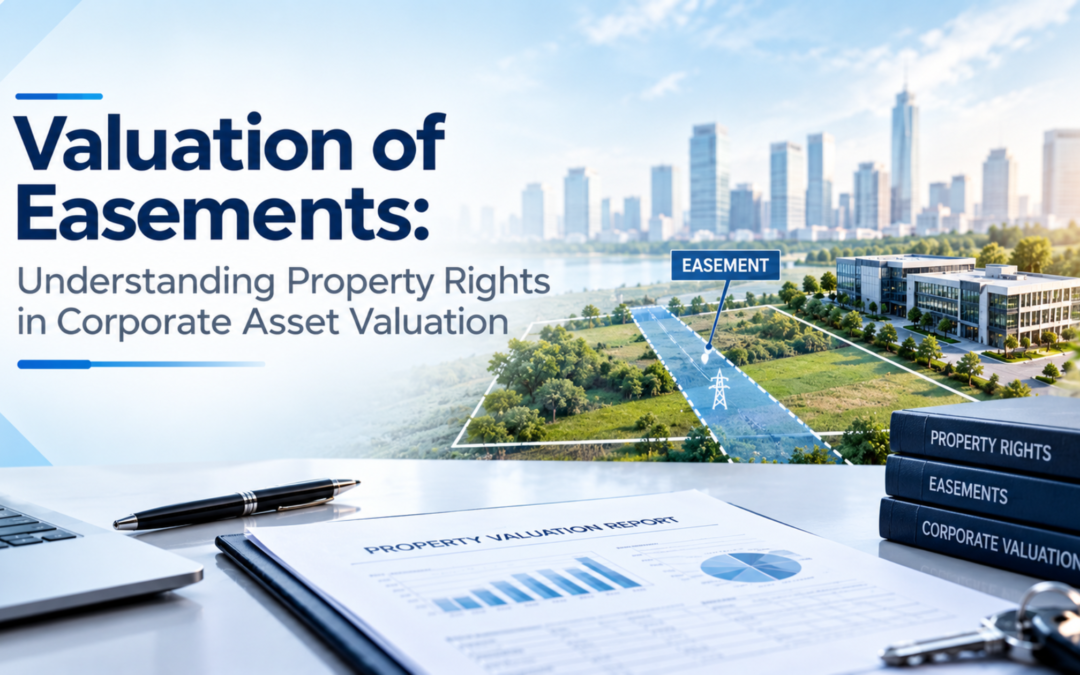
When a company owns land or commercial property, its value is not always determined by the physical property alone. Certain legal rights, restrictions, access arrangements, or rights enjoyed by neighbouring properties can also affect how a property is used and, in some situations, how its value is assessed. One such consideration is an easement.
The Valuation of Easements can therefore become relevant when a company owns, uses, transfers, or is affected by land subject to an easementary right.
At Tanuj Kumar & Associates, the focus is on professional asset valuation rather than valuation of companies or their shares. The firm’s scope includes Land & Building, Plant & Machinery, and Inventory. For corporate property assignments, understanding the characteristics and legal circumstances surrounding the underlying asset is an important part of the valuation process.
For more information about the firm’s valuation services, visit www.valuer.co.in.
What Is an Easement?
An easement is generally a right attached to land that allows a particular use of another property or imposes a corresponding restriction on the use of that property. Common examples can include rights relating to access, pathways, drainage, light, air, or the passage of utilities, depending on the circumstances and applicable law.
For a company holding land or a building, such rights may influence the practical use of the property.
For example, a commercial property may be subject to a right of way that allows another property owner to access a particular area. Similarly, a utility-related right may restrict construction or development within a specified portion of the land.
These circumstances can become relevant when assessing the value of the underlying property.
Why Valuation of Easements Matters for Corporate Assets
The Valuation of Easements is primarily connected with the rights and restrictions associated with land. This makes it particularly relevant to the valuation of corporate Land & Building assets.
A company’s property may have a different practical utility depending on whether third parties have established rights over part of the land. The effect may depend on the location, extent, nature, duration, and legal status of the easement, as well as the physical characteristics of the property.
A Registered Valuer considers the available information and the purpose of the assignment before determining the appropriate approach.
Importantly, this does not mean valuing the company itself. The assignment remains focused on the physical asset and the relevant property rights affecting that asset.
How Easements Can Affect Property Value
An easement does not automatically mean that a property has a lower value. Its effect depends on the specific circumstances.
For example, an access easement may have limited impact where the affected area is already used as a common access route. In another situation, an easement could restrict development or construction over an otherwise usable part of a property.
The assessment may therefore require consideration of:
- Location of the affected land
- Extent of the easement
- Nature of the right
- Purpose for which the right is exercised
- Duration and legal status
- Impact on access or development
- Existing use of the property
- Potential restrictions on construction
- Market conditions
- Relevant property documents
The relationship between these factors needs to be understood before reaching a valuation conclusion.
The Role of a Registered Valuer
A Registered Valuer brings a structured professional approach to the assessment of eligible assets. In an assignment involving an easement, the Registered Valuer may need to understand the physical property, available documents, site conditions, and the effect that the relevant right or restriction may have on the asset.
The Valuation of Easements can therefore require both property knowledge and technical understanding.
However, the Registered Valuer’s role should not be confused with that of a legal professional. Questions concerning the validity, creation, enforceability, or interpretation of legal rights may require appropriate legal advice. The valuation assessment can consider the relevant documented facts and their implications for the asset, within the scope of the assignment.
Valuation of Easements in Delhi NCR
Corporate properties across the National Capital Region (Delhi NCR) can have varied land-use and development characteristics. This includes properties in Delhi, Gurgaon, Noida, Greater Noida, Faridabad, Manesar, and Ballabgarh, along with areas such as Sonepat and Bahadurgarh.
An easement affecting an industrial property may have different implications from one affecting an office building, warehouse, or other commercial property.
Local conditions, accessibility, surrounding development, infrastructure, land use, and the property’s existing configuration can all be relevant.
This makes a property-specific assessment important rather than relying on a general assumption about the effect of an easement.
Corporate Land & Building Valuation
For companies, Land & Building can form a significant part of the physical asset base. A valuation may be required for purposes such as financial reporting, financing, taxation, insurance, restructuring, property transactions, or other corporate requirements.
Where an easement exists, the relevant property documents and site circumstances can form part of the information considered during the assignment.
The Valuation of Easements can consequently form part of a broader assessment of the rights and restrictions associated with corporate property, where applicable to the purpose of the valuation.
The objective remains to arrive at a reasoned assessment of the relevant asset based on its characteristics and the information available.
Our Asset Valuation Expertise
Tanuj Kumar & Associates focuses on valuation of physical assets rather than valuation of companies.
The firm’s stated scope includes Land & Building, Plant & Machinery, and Inventory. Its website also lists services relating to land valuation, Registered Property Valuation, commercial property valuation, institutional property valuation, mortgage property valuation, infrastructure valuation, insurance valuation, and other asset-related assignments. More information is available at www.valuer.co.in.
The firm’s website identifies professional experience combining engineering and financial knowledge with valuation practice. It also states that the practice has around 30 years of experience as an engineer and valuer. (valuer.co.in)
This technical background can be useful when assessing corporate physical assets where construction, condition, use, location, and other property characteristics need to be considered.
A Careful Approach to Easement-Related Assignments
Every property is different. An easement that has little practical effect on one property could be considerably more relevant to another.
A careful Valuation of Easements should therefore begin with an understanding of the specific property, the relevant right or restriction, the purpose of the assignment, and the information available.
The assessment may involve reviewing property documents, understanding the physical configuration of the site, considering the practical effect of the easement, and examining appropriate market evidence where relevant.
The final conclusion should reflect the circumstances of the particular asset rather than relying on a standard percentage adjustment or assumption.
Why Professional Experience Matters
Asset valuation requires an understanding of the subject property as well as the purpose for which the valuation is being prepared.
Tanuj Kumar & Associates provides valuation services with an emphasis on engineering and asset-related expertise. The practice’s website provides details of its professional background, valuation services, and contact information at www.valuer.co.in.
For corporate property owners, this asset-focused approach helps maintain an important distinction: the firm evaluates assets owned or held by companies, including Land & Building, Plant & Machinery, and Inventory. It does not provide valuation of companies as business entities.
Conclusion
The Valuation of Easements can be an important consideration where a corporate land or building asset is affected by rights, access arrangements, or other restrictions associated with neighbouring properties.
A proper assessment requires attention to the individual circumstances of the property, the nature of the easement, relevant documentation, physical conditions, and the purpose of the valuation.
For organisations requiring asset valuation support, Tanuj Kumar & Associates provides Registered Valuer services focused on physical assets, including Land & Building, Plant & Machinery, and Inventory.
To learn more about the firm’s services and professional expertise, visit www.valuer.co.in.